
House Window Tinting Melbourne: A Practical Guide to Keeping Your Home Cooler
Melbourne weather has a habit of keeping us guessing. A comfortable morning can turn into a hot afternoon, and once the sun starts streaming through large windows, some rooms can heat up surprisingly quickly.
If you have a west-facing living room, large floor-to-ceiling windows or a home that gets strong afternoon sun, you have probably experienced it. The air conditioner is running, the blinds are closed, but you can still feel the heat coming through the glass.
That is where house window tinting can help.
Residential window tinting involves applying a thin film to your existing glass to change the way solar energy, visible light and ultraviolet radiation pass through the window. Depending on the film you choose, it can reduce solar heat gain, control glare, block UV, improve daytime privacy and make sunny rooms more comfortable.
But window tint is not magic, and not every film is right for every window.
Here is what Melbourne homeowners should understand before choosing window film.
Why can rooms with large windows become so hot?
Windows are an important part of a home’s design. They bring in natural light, create views and make rooms feel open.
The downside is that sunlight can also bring a considerable amount of heat into the house.
Australian Government passive-design guidance explains that solar heat gain through glazing changes according to the direction the window faces, the season, the position of the sun and the angle at which sunlight strikes the glass.
West-facing windows can be particularly challenging in summer because the afternoon sun strikes them at a relatively low angle. That can result in significant solar heat gain at exactly the time when the outside temperature is already high.
Anyone with a west-facing lounge room probably does not need the science explained to them. You can often feel the difference simply by standing near the window at 4 pm on a hot day.
Victoria is also no stranger to extreme heat. On 27 January 2026, temperatures of 48.9°C were recorded at Walpeup and Hopetoun, setting a new Victorian state temperature record.
Melbourne did not reach those temperatures, but the event was another reminder of how severe Victorian heat can become.
What does house window tinting actually do?
Window film is applied to your existing glass and modifies how solar energy passes through it.
Different products are designed for different purposes, but residential solar-control films commonly help with four problems.
1. Reducing solar heat
Solar-control film can reflect, absorb or otherwise reduce part of the solar energy that would normally pass through your windows.
Less solar heat entering through the glass can mean fewer hot spots and a more comfortable room.
It may also reduce the load on your air conditioner, particularly in rooms exposed to strong sunlight.
However, it is important to keep expectations realistic.
Window tint only deals with the windows. It cannot compensate for poor roof insulation, uninsulated walls, air leakage or other parts of the building envelope.
Think of window film as one part of making a home more comfortable rather than a replacement for good insulation, shading and efficient heating or cooling.
2. Reducing glare
There is a difference between having plenty of natural light and having sunlight shining directly across your television or computer screen.
Glare is particularly noticeable in living rooms, home offices and rooms with large windows.
Darker or more reflective films can significantly reduce visible light and therefore reduce glare.
The right choice depends on how much natural light you want to keep.
3. Blocking UV
Quality architectural window films can block very high percentages of ultraviolet radiation.
Tint Minister’s residential films are specified as blocking up to 99% of UV, depending on the product.
That can help protect flooring, furniture, artwork, curtains and other interior finishes.
It is worth remembering, though, that UV is not the only reason furnishings fade. Visible light and heat also contribute to fading over time. Window film can slow the process, but no film can guarantee that furniture or flooring will never fade.
4. Improving daytime privacy
Reflective films can make it considerably harder to see into a house during daylight.
This can be useful for homes facing busy streets, footpaths or neighbouring properties.
There is one important catch.
Reflective privacy relies on a difference in light levels. During the day, when it is brighter outside than inside, the reflective side helps obscure the view into the home.
At night, when the lights are on inside and it is dark outside, that effect can reverse.
So if your main goal is complete night-time privacy, reflective window tint alone may not be enough. Curtains, blinds or frosting may still be needed.
What types of house window tint are available?
There is no single “best” residential window film.
The right film depends on your windows and what you want to achieve.
Tint Minister offers several categories of residential solar-control film.
High-reflective window film
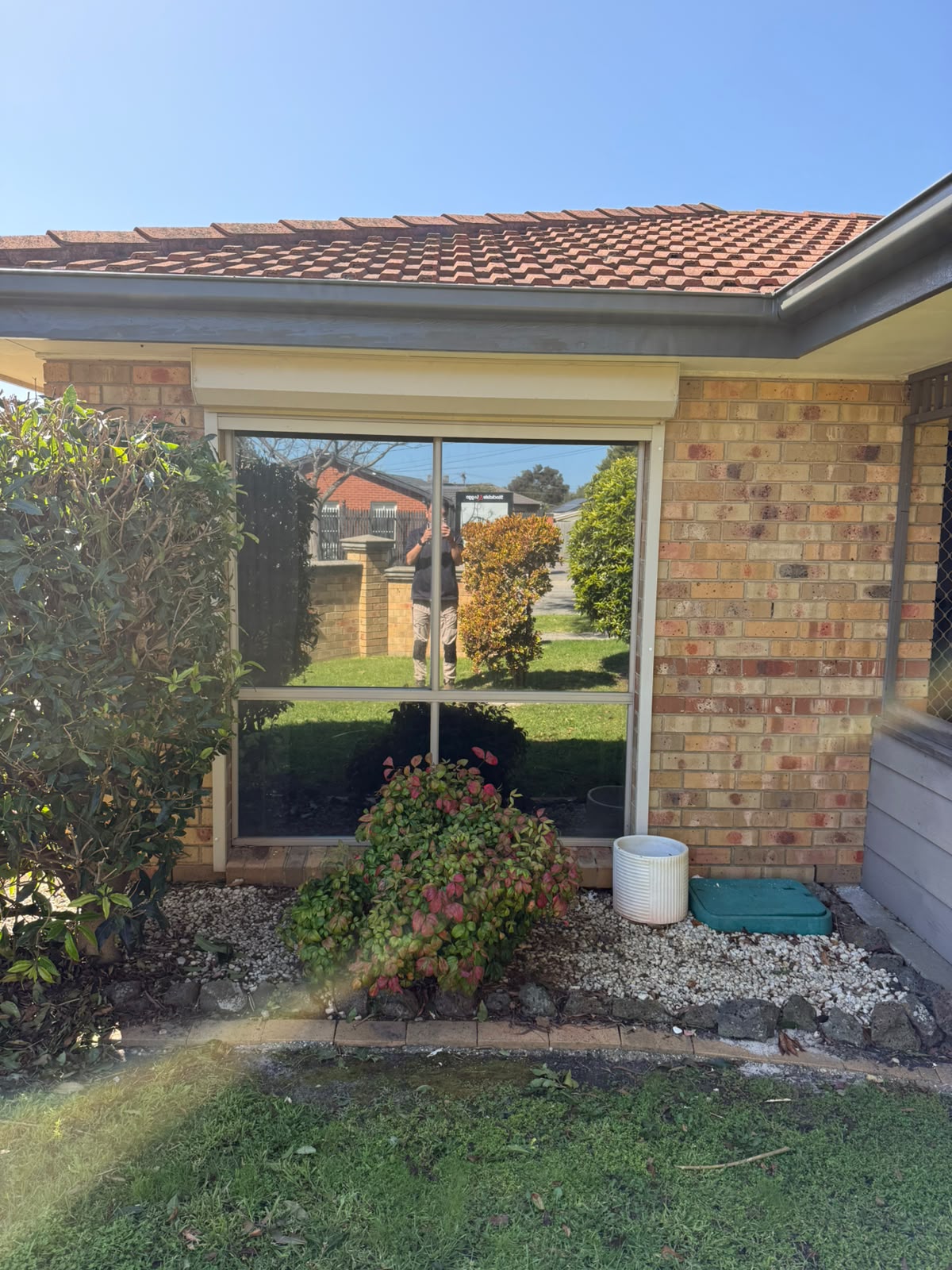
High-reflective film has the familiar mirror-like appearance that many people associate with architectural window tint.
It is generally selected when controlling solar heat is the main priority.
Tint Minister’s currently published figures for its high-reflective residential range include:
- up to 80% solar heat rejection
- up to 78% glare reduction
- up to 99% UV protection.
Because of its reflective exterior appearance, it can also provide strong daytime privacy.
The trade-off is aesthetics. Not everybody wants their home to have noticeably reflective windows.
Dual-reflective window film
Dual-reflective films are designed differently on each side.
The outward-facing surface is more reflective to help control solar energy, while the indoor-facing side is more neutral.
That matters because highly reflective glass can sometimes create distracting reflections when you are looking outside from a darker room, particularly in the evening.
Tint Minister currently lists performance of up to:
- 71% solar heat rejection
- 84% glare reduction
- 99% UV protection
for its dual-reflective residential options.
These films can be a useful compromise when you want good solar control without having a strong silver appearance from inside the house.
Low-reflective or “black” tint
Low-reflective films provide a darker, more understated appearance.
Rather than creating a strong mirror finish, they reduce visible light and create a darker appearance through the glass.
Tint Minister currently lists its low-reflective options as providing up to:
- 65% solar heat rejection
- 72% glare reduction
- 99% UV protection.
For some homeowners, the visual appearance is just as important as maximum heat rejection, which makes this style worth considering.
Low-E window film
Low-emissivity, or Low-E, films are designed with year-round thermal performance in mind.
Conventional solar-control tint is primarily associated with reducing incoming solar heat.
Low-E film can also help reduce heat transfer through the window, making it relevant in winter when you are trying to retain warmth indoors.
That is particularly interesting in Melbourne because our climate creates both cooling and heating demands.
Low-E film is not a substitute for double glazing, and the two technologies work differently, but it can be an option worth investigating when replacing all your windows is not practical.
Understanding VLT, heat rejection and SHGC
Window-film specifications can become confusing very quickly.
You might see numbers for VLT, UV rejection, infrared rejection, total solar energy rejected and SHGC.
They are not interchangeable.
VLT
VLT means visible light transmission.
If a film has a VLT of 20%, roughly 20% of visible light is transmitted through the filmed glass under the specified test conditions.
Lower VLT generally means a darker appearance.
Higher VLT generally means a lighter, more transparent appearance.
A common mistake is assuming that darker film automatically rejects more heat.
That is not necessarily true.
Modern films can use different coatings and technologies to control solar energy while allowing relatively high levels of visible light through.
So choose VLT based partly on how bright you want the room to feel, rather than treating it as a measure of heat performance.
Total solar energy rejected
Total solar energy rejected, often shortened to TSER, describes the proportion of total incoming solar energy that a glazing system rejects.
It provides a more useful indication of overall solar-control performance than looking at one narrow section of the infrared spectrum.
SHGC
SHGC means solar heat gain coefficient.
Rather than measuring how much solar energy is rejected, SHGC measures how much enters through the glazing.
A lower SHGC therefore means lower solar heat gain.
SHGC is also used within Australian window energy-performance assessments.
One reason these numbers matter is that headline percentages are not always directly comparable between manufacturers.
One film might advertise infrared rejection while another publishes total solar energy rejection. Those two percentages measure different things.
When comparing films, make sure you are comparing the same measurement.
Which windows benefit most from tinting?
It makes sense to prioritise the windows creating the biggest problem rather than automatically tinting every pane of glass in your house.
West-facing windows are often strong candidates because of the low afternoon sun.
East-facing glazing can have similar problems in the morning.
Large unshaded windows may also allow substantial solar gain, depending on their orientation.
North-facing glazing is more complicated in southern Australia because well-designed north-facing windows can provide useful winter sunshine while appropriately sized shading can block high summer sun.
In those situations, excessively reducing solar gain may have an unwanted effect during winter.
That is why good residential tinting should start by understanding the home rather than simply applying the darkest film available.
Can you tint double-glazed windows?
Often, yes — but film selection becomes especially important.
Different glazing types respond differently to absorbed solar energy.
Some films absorb more heat than others. As the film and glass heat up, temperature differences across the pane can create thermal stress.
Under certain conditions, excessive thermal stress can contribute to glass breakage.
The risk depends on factors including:
- the type of glass
- whether it is annealed, toughened or laminated
- whether it is single or double glazed
- existing coatings on the glass
- film absorption characteristics
- pane dimensions
- partial shading
- the window’s exposure to sunlight.
Low-E coated glass also requires particular care because the position of the Low-E coating and the construction of the glazing unit affect which films are appropriate.
For this reason, an installer should identify the glass and check film compatibility before installation.
If your windows are still covered by the window manufacturer’s warranty, it is also worth checking whether applying aftermarket film affects that warranty.
Will window tint make your home too dark?
It can — if you choose a film that is darker than you need.
But residential window tint does not have to make the house feel gloomy.
There are films available with substantially different levels of visible light transmission.
For a room that is already dark, maintaining natural light may be the priority.
For a large west-facing living room that becomes almost unusable on summer afternoons, stronger glare and heat control might matter more.
The best way to choose is to look at film samples against your actual windows.
A sample allows you to compare colour, reflection and brightness in the room where the film will eventually be installed.
What does house window tinting cost?
There is no meaningful universal “price per square metre” for every residential tinting project.
Several factors influence the cost.
The obvious one is how much glass needs to be covered, but the size and shape of individual panes also matter.
Architectural films come in standard roll widths. A pane that is slightly wider than one available film width may require material from the next size up, resulting in more wastage.
Other factors include:
- the film selected
- the number and size of windows
- the type of glass
- timber versus aluminium frames
- old silicone, paint or contamination that needs to be removed
- second-storey or difficult access
- unusually large panes
- scaffolding or specialist access requirements.
The most useful approach is therefore to have the windows assessed and receive a quote based on the actual job.
What should you expect after installation?
Window film is normally installed using a water-based slip solution.
The glass is thoroughly cleaned, the film is positioned, and most of the solution is removed with a squeegee.
Some moisture remains between the glass and film immediately after installation.
As a result, newly tinted windows can sometimes appear cloudy, hazy or show small moisture pockets.
That does not automatically mean something has gone wrong.
The remaining moisture needs time to evaporate while the adhesive cures.
Depending on the film and weather conditions, this can take days or weeks. In cooler or less sunny Victorian conditions, complete drying can sometimes take considerably longer.
Do not puncture water bubbles or try to force moisture out yourself.
Once the film has cured, keep it clean using a soft microfibre cloth, soft sponge or suitable squeegee rather than abrasive tools.
Is window tinting right for your Melbourne home?
If your main problem is strong sunlight coming through your glass, residential window film can be a practical way to improve comfort without replacing the windows.
It is particularly worth considering when you are dealing with:
- hot west- or east-facing rooms
- excessive glare
- fading furniture or flooring
- large areas of unshaded glazing
- lack of daytime privacy
- rooms that place a heavy load on air conditioning.
The important part is choosing the right film.
Maximum heat rejection is not automatically the right answer for every window. Your home’s orientation, glass type, natural light, privacy requirements and the appearance you want all need to be considered.
At Tint Minister, we assess the glass and understand what you are trying to fix before recommending a film.
That might mean a highly reflective solar-control film for a hot west-facing window, a dual-reflective option that maintains a more neutral view from inside, a lower-reflective film for a darker appearance or a Low-E product where year-round thermal performance is the priority.
The aim is not simply to make the glass darker.
It is to make the window work better for the way you use your home.
House window tinting FAQs
Does house window tinting really reduce heat?
Solar-control window film can reduce the amount of solar energy passing through glass. How noticeable the difference is depends on the film, glazing, window orientation, shading and amount of direct sun. It tends to make the biggest difference on windows receiving strong solar exposure.
Does window tint block UV?
Many quality architectural films block up to 99% or more of ultraviolet radiation, depending on the product. Reducing UV can help slow fading, although visible light and heat also contribute to fading.
Can I see through reflective window tint at night?
Reflective tint does not provide reliable one-way privacy at night. If it is dark outside and your lights are on indoors, people outside may still be able to see inside. Curtains, blinds or another privacy treatment may be necessary.
Can double-glazed windows be tinted?
Often they can, but the film must be compatible with the glazing system. Double glazing, laminated glass and Low-E coatings require more careful film selection because of thermal-stress and warranty considerations.
Is darker tint better at rejecting heat?
Not necessarily. Darkness is primarily related to visible light transmission. Different film technologies can have very different solar-energy performance even when they transmit similar amounts of visible light.
Will I still need blinds or curtains?
Possibly. Film and window furnishings perform different jobs. Tint can reduce incoming solar energy and glare before it reaches the room, while blinds and curtains are useful for privacy, light control and interior design. Many homes use both.
Find the right window tint for your home
If one part of your house becomes noticeably hotter than the rest, glare makes the room difficult to use, or you simply want more daytime privacy without keeping the blinds closed, it is worth having the windows assessed.
Tint Minister provides residential window tinting across Melbourne and can help identify a film suited to your glass, orientation and priorities.
Get in touch for a free quote and we can help you work out which option makes sense for your home.